
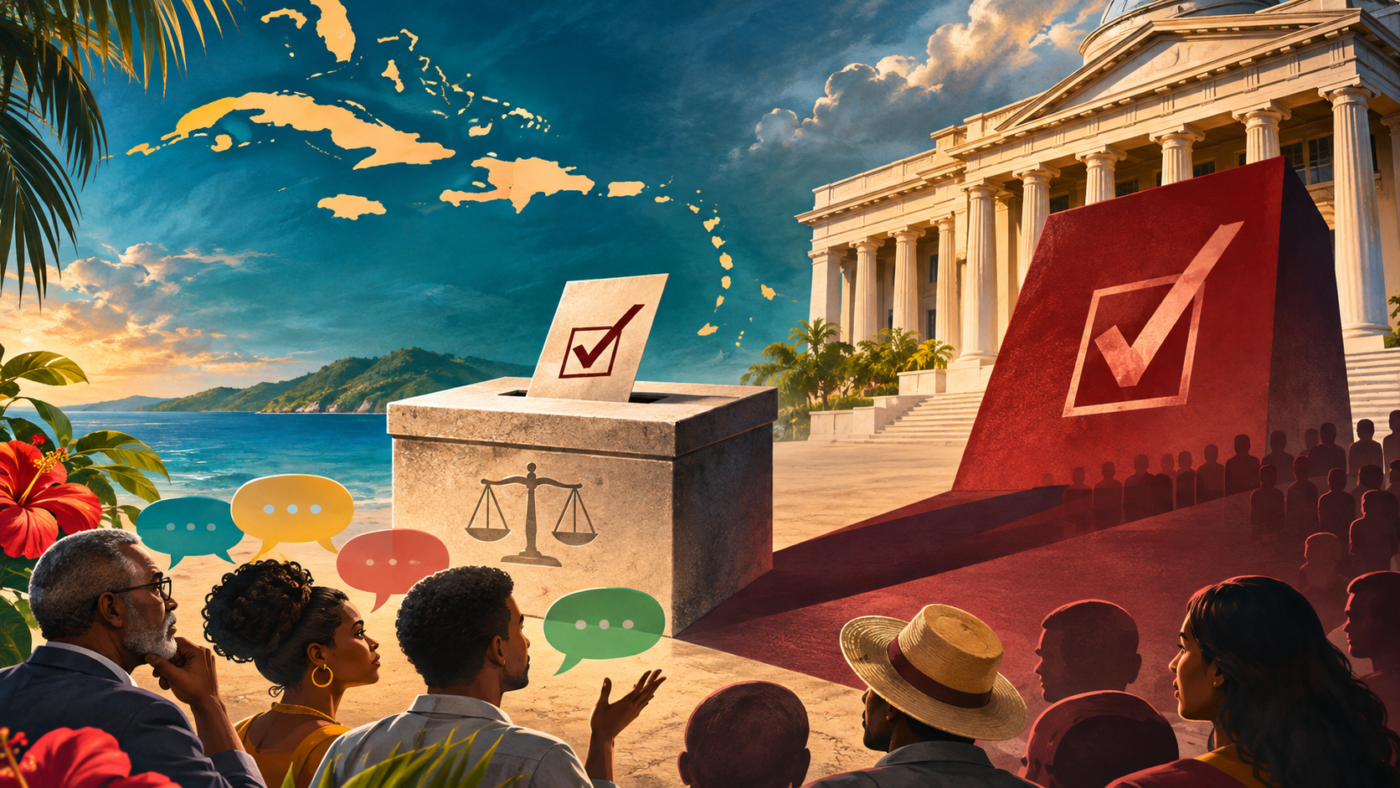
WHEN THE GOVERNMENT WINS ALMOST EVERYTHING – DOES DEMOCRACY LOSE SOMETHING?
Electoral mandates, diminished Opposition representation and the urgent need to strengthen democratic accountability in the Caribbean.
Democracy is not simply about who wins an election. It is also about what happens after the votes are counted.
Across the Eastern Caribbean, recent general elections have produced extraordinary victories for governing parties. In Barbados, the Barbados Labour Party secured all 30 elected seats in February 2026. In Saint Lucia, the Saint Lucia Labour Party won 14 of 17 seats. In Saint Vincent and the Grenadines, the New Democratic Party captured 14 of 15 seats. In Antigua and Barbuda, the Antigua and Barbuda Labour Party secured 15 of 17 seats, and more recently in Grenada’s November 5, 2026 general election, the National Democratic Congress secured 14 of the 15 contested seats.
These are decisive electoral outcomes. They reflect the choices made by voters and must be respected. No democratic society should begrudge a political party an overwhelming victory when that victory is achieved through free, fair and transparent elections.
But there is a question we must confront, one that goes beyond the fortunes of individual political parties: When one party wins almost everything, who is left to hold the Government accountable?
This is not an argument against strong governments. It is an argument against unchecked power.
The Westminster parliamentary system, inherited and practiced throughout much of the Caribbean, rests on an important democratic principle: Government must be answerable to Parliament, and Parliament must be capable of scrutinizing the Government.
The Opposition is therefore not an inconvenience to the governing party. It is an essential pillar of parliamentary democracy.
Its responsibility is to question ministers, scrutinize legislation, and examine public expenditure, challenge questionable policies and present alternative approaches to national development. It gives parliamentary expression to the concerns of citizens who did not vote for the governing party. It also provides a credible alternative government, ensuring that political power remains temporary and subject to the judgment of the electorate.
What happens, however, when the Opposition is reduced to one elected representative? What happens when a governing party occupies every elected seat in the lower house, as occurred in Barbados? Can parliamentary scrutiny be effective when the political balance within the Legislature is so heavily weighted in favor of the Executive?
These are not merely academic questions. They go to the heart of how our democratic institutions function.
In small Caribbean states, the problem is particularly serious. Our parliaments are relatively small, and the Executive and Legislature are closely connected. Ministers are generally drawn from the governing parliamentary majority. When that majority becomes overwhelming, the distinction between the Government’s political authority and Parliament’s oversight responsibility can become blurred.
Government backbenchers have a duty to scrutinize Cabinet decisions, but party loyalty and political discipline can make independent challenges difficult. Parliamentary committees may also struggle to provide effective oversight when Opposition representation is severely limited.
The result can be a Parliament that increasingly approves Government decisions rather than rigorously examining them.
This is where the democratic danger lies.
An overwhelming parliamentary majority does not automatically mean that the governing party received an equivalent proportion of the popular vote. Under the first-past-the-post electoral system, a party can win a commanding majority of seats without securing anything close to the same proportion of votes nationally.
A party may receive a relatively modest majority of votes but capture an overwhelming share of parliamentary seats. Another party may receive substantial support across the country and yet secure very few representatives. The electoral system may permit such an outcome, but we should not confuse the legal right to govern with an unrestricted mandate to exercise power.
Winning an election is not winning ownership of the state.
The people who voted for the Opposition remain citizens with equal rights. Their concerns about jobs, healthcare, education, housing, public services, taxation and national development do not become less important because their preferred candidates lost.
Democracy must protect the rights of the majority to govern, but it must also protect the rights of minorities to be heard.
This is why the Caribbean must seriously reconsider whether its existing parliamentary arrangements are adequate for the political realities of small states.
We should examine reforms that guarantee meaningful parliamentary representation for parties receiving significant electoral support. Mixed-member proportional representation deserves serious consideration. So too does strengthening the role of parliamentary committees, ensuring that the Public Accounts Committee can function independently, and providing Opposition members with the research and administrative resources necessary to perform their responsibilities. The chairmanship of the Public Accounts Committee is normally entrusted to the Leader of the Opposition, and should be provided with the resources and authority to examine government expenditure and public administration without political interference.
We must also strengthen the independence of the Auditor General, Electoral Commissions, Director of Public Prosecutions, integrity commissions/institutions and other constitutional offices. Freedom of information, transparent procurement and meaningful public consultation must become central features of democratic governance.
These safeguards should not depend on the goodwill of whichever party happens to be in office.
There is also a responsibility that Opposition parties cannot escape. A weak Opposition cannot blame every failure on an overwhelming Government majority. Opposition parties must demonstrate competence, discipline, integrity and a willingness to offer credible alternatives. They must engage citizens, develop policies, renew their leadership and prepare themselves to govern.
But the greater responsibility rests with those who exercise state power. A Government that has been entrusted with an overwhelming mandate should demonstrate the confidence to welcome scrutiny, respect parliamentary procedures and protect institutions that may sometimes challenge its decisions.
The implications for Dominica, and the other countries cited in this article are particularly important. Our national conversation on electoral reform must extend beyond voter registration, constituency boundaries and the mechanics of conducting elections. It must address the broader constitutional architecture of governance: the relationship between the Executive and Legislature, the role and resources of the Opposition, the independence of constitutional offices, parliamentary oversight and the right of citizens to participate meaningfully in public affairs.
We should not wait until our own Parliament faces an extreme imbalance before addressing these questions.
The Caribbean Community and the Organization of Eastern Caribbean States should also encourage a regional conversation on strengthening parliamentary democracy. Our constitutional arrangements may differ in important respects, but the challenges facing small parliamentary democracies are remarkably similar.
The ultimate objective is not to weaken elected governments. It is to strengthen democracy itself.
A Government must have the authority to govern. An Opposition must have the capacity to hold it accountable. Parliament must remain an institution of scrutiny and debate, not simply a rubber stamp for Cabinet. Independent institutions must be protected, and citizens must never surrender their democratic voice between elections.
The lesson is clear: the size of a Government’s majority should never determine the strength of its accountability. Our region must move beyond the narrow notion that democracy begins and ends at the ballot box. It must be measured by the quality of governance, the integrity of public institutions, the transparency of decision-making and the willingness of those in power to answer to the people.
The Government may win the election, but it does not own Parliament, the institutions of state or the people of the country.
A strong Government needs a strong Parliament. A strong Parliament needs an effective Opposition. And a healthy democracy requires that no Government, however overwhelming its electoral victory, should ever be beyond accountability.
The Government may win the election, but the people must never lose their voice.
#### END ###
Sign in to comment
Signing in is optional. You are welcome to fill in the form below instead.