
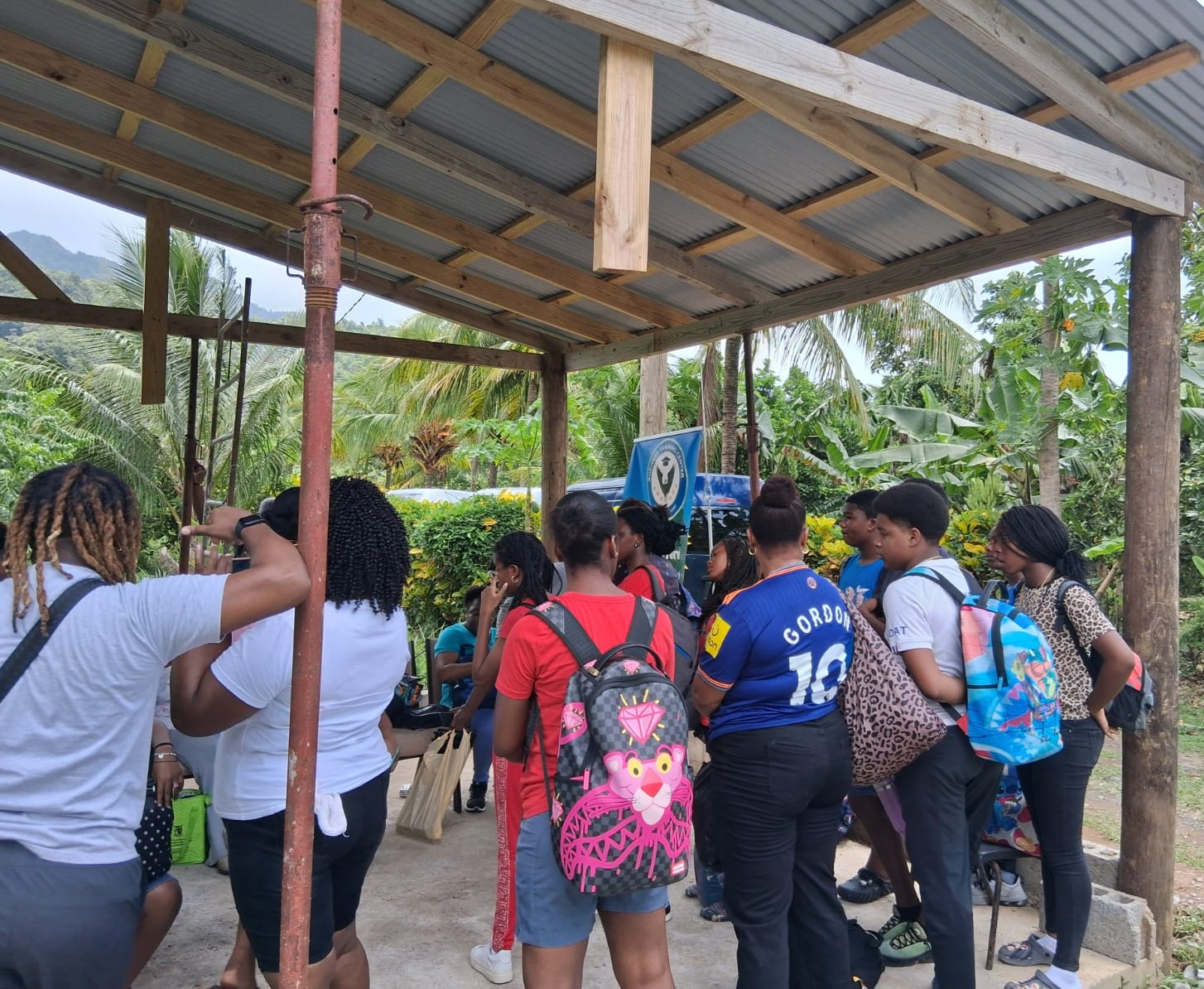
Castle Bruce Farm Wraps Up Youth Agriculture Camp, Signals a Different Future for Young Farmers
Thirty to forty young people, most between the ages of 13 and 25, spent two weeks this summer on Pastor Adrien Bannis’s farm in Castle Bruce, learning agriculture not from a textbook but from the soil itself. The camp, which concluded this week, is part of an ongoing effort by Bannis and his family to draw a new generation into food production at a time when much of Dominica’s arable land sits idle.
Pastor Bannis, spoke about the camp during his appearance on this week’s episode of This Weekend Interview with host Anthony Drigo, said the structure of the program was deliberate. The first week covered theory: land preparation, tree varieties and the broader importance of agriculture, much of it taught by his daughter. Each session was paired with hands on activity, including bed preparation so participants could plant something themselves.
“You cannot train people in a place where they are not seeing what you are telling them happening,” Bannis said, describing the philosophy behind the camp’s design. He compared it to trying to teach someone about transportation without ever showing them a vehicle. Students needed to touch the crops, taste the fruit and watch the planting happen in front of them, not just hear about it in a classroom.
The second week shifted to processing. Campers made pineapple jam, breadfruit flour and cocoa sticks, working the cocoa from pod through roasting and grinding to the finished product. The breadfruit flour was a particular hit, Bannis said, with participants taking bags of it home, along with jam they had used earlier as a dip for their own farm made chips.
Participants came from across the Castle Bruce area and surrounding communities, including Sultan, Kalago territory and Wapo, according to Banis. Many, he said, already had access to family land, and several expressed interest in returning, in part because of a pitch competition tied to the program. A partner organization based in the United States is offering a two thousand dollar prize to a participant with the strongest idea, part of a broader relationship Banis has built with an American backer whose own agricultural work spans several countries.
Bannis said the camp also introduced students to record keeping and yield data, the kind of information he argues is largely missing from farming in Dominica. He used dasheen as an example, describing how a grower who tracks input costs, planting timelines and expected yield per acre can better time sales against a market where dasheen prices have climbed steadily, from fifty cents per pound to two dollars over recent years, with further increases expected.
One student in particular stood out to him. Bannis described asking the young man a question during the processing sessions and being impressed enough by the answer that he offered to bring him on for future large scale flour production runs, an offer the student accepted.
The camp also introduced students to agroforestry, a practice Bannis has built his own farm around and which he described as Dominica’s only full example of the model. He explained agroforestry as an approach to farm layout that accounts for wind direction, water runoff and soil protection, often using trees that double as windbreaks and food sources rather than serving a single purpose. He drew a comparison to crumple zones in vehicle design, where a structure is built to absorb and dissipate force rather than transmit all of it to what is being protected.
Beyond the camp, Bannis pointed to broader work underway through the Dominica chapter of the Agricultural Alliance of the Caribbean, an organization he said has already trained close to 100 farmers in areas including pruning, grafting, budding, pest control, water harvesting and record keeping. The group’s annual general meeting is scheduled for September 10, and Bannis said its next priority is building a centralized marketing arm so farmers have a reliable buyer and processing point for their produce, rather than each grower having to find a market individually.
He pointed to the earlier banana industry model, with its growers association handling farming support and a separate marketing corporation handling export and sales, as a structure worth revisiting for agriculture more broadly.
Bannis also discussed plans for a hydroponics system on the farm, intended primarily for lettuce and bok choy, and described ongoing use of rabbit byproducts, both urine and manure, as low cost pest management and fertilizer inputs. He said he is also looking into biodigester technology that would allow larger livestock operations to convert manure into cooking gas while still producing usable fertilizer from the residue.
Asked about praedial larceny, the theft of crops from farmland that has historically discouraged growers, Bannis said it is not currently a significant problem in the Castle Bruce area. He attributed a decline in past offenders less to enforcement than to a broader decline in active farming and reduced acreage under cultivation.
Bannis closed by encouraging members of the Dominican diaspora to support the program in whatever way they can, framing the camp as part of a longer term effort to rebuild interest in farming among young people whose parents already hold land but have not necessarily worked it themselves. Another cohort of the youth program began this week, and Bannis said he expects to run it again next year.
Sign in to comment
Signing in is optional. You are welcome to fill in the form below instead.