
Barbados’ Mia Mottley Defends Reparations Push, Dismisses UK Criticism as Global Debate Intensifies
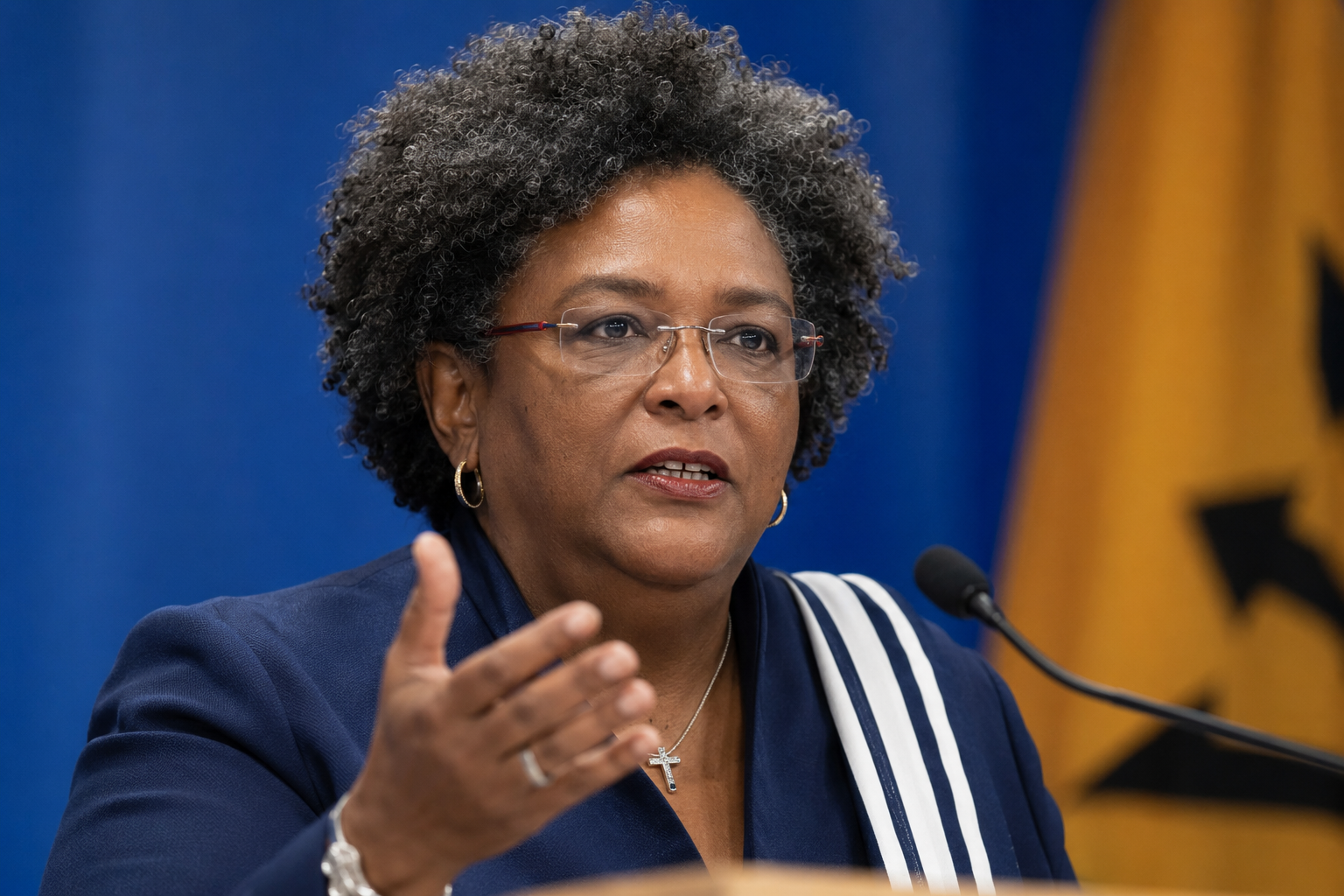
Barbados Prime Minister Mia Amor Mottley has forcefully defended the Caribbean’s campaign for reparations for slavery, rejecting criticism from some British politicians and insisting that the movement is rooted in justice rather than financial compensation or political symbolism.
Speaking in her capacity as chair of the Caribbean Community (CARICOM) Prime Ministerial Subcommittee on Reparations, Mottley responded to questions about growing resistance in the United Kingdom to reparations claims. Her remarks came amid reports that some UK parliamentarians have suggested visa restrictions on leaders from countries pursuing reparations, while at least one British political figure controversially argued that Caribbean nations should instead be grateful to the British Empire for its historical role.
Mottley did not hide her frustration. “I’m not sure that you want me to reply to things that really are asinine,” she said to laughter from the audience before directly addressing the suggestion that Caribbean nations owed Britain anything.
“The notion that we should pay the United Kingdom for oppressing us, for enslaving us and for treating us as cattle,” she said, underscoring what she described as one of the defining characteristics of transatlantic slavery under British colonial rule.
Mottley argued that while slavery existed in various forms throughout history, the Atlantic slave system institutionalized a particularly brutal legal framework.
She pointed specifically to Barbados’ 1661 Slave Code, one of the earliest comprehensive slave laws in the English colonies, which she said established the legal treatment of enslaved Africans as property—or “chattel.” According to Mottley, the code became a model for later slave legislation throughout Britain’s American colonies.
“The difference,” she argued, “was the treatment of human beings as cattle.”
Her reference comes against the backdrop of ongoing historical debates over colonial legal systems. Historians widely acknowledge that the Barbados Slave Code influenced later slave laws across British North America, embedding racial slavery into colonial law for generations.
“We’re Not Asking for Charity” Mottley rejected suggestions that reparations amount to demands for aid or handouts.
“We’re not asking for charity,” she declared.
“We’re asking to be able to ensure that justice can be done.”
She pointed to Britain’s own historical actions following the Slavery Abolition Act of 1833. When slavery was abolished across most of the British Empire in 1834, the British government allocated £20 million, an enormous sum at the time, to compensate slave owners for the loss of what the law regarded as their property. The enslaved themselves received no compensation.
That historical reality has become one of the central arguments advanced by advocates of reparatory justice. Mottley urged critics to familiarize themselves with the historical record before commenting.
“I would like to advise that those who have not yet read sufficient to understand the history do so before making comments that really do not reflect well on them.”
Despite resistance from some political figures in Britain, Mottley argued that the reparations movement continues to gain international legitimacy.
She cited several developments she believes demonstrate growing global engagement with the issue.
Among them:
- Discussions held recently in Accra, Ghana, where African and Caribbean leaders have increasingly coordinated positions on reparatory justice.
- A United Nations resolution introduced by Ghana that she described as advancing the international conversation.
- Recent comments by Pope Leo acknowledging the historical legacy of slavery and colonialism.
- French President Emmanuel Macron’s willingness to engage in discussions surrounding reparations.
- Statements by King Charles III, made while he was Prince of Wales during the Commonwealth Heads of Government Meeting in Rwanda, recognizing that reparations are a conversation “whose time had come.”
For Mottley, these developments suggest that the issue has moved beyond the Caribbean and into mainstream international diplomacy.
“This is a global movement,” she said.
Mottley suggested that much of the sharp rhetoric emerging from Britain reflects domestic political calculations rather than genuine engagement with the historical issues.
“I have no doubt that there are British parliamentarians who want to distract people from the domestic politics of the United Kingdom at this point in time,” she said.
“But the Caribbean should not be used as a prop in those circumstances.”
Her remarks come ahead of another Commonwealth Heads of Government Meeting, where questions surrounding colonial history, development financing, climate justice and reparations are expected to remain on the agenda.
The issue of slavery reparations remains one of the most contentious subjects in international politics.
Supporters argue that European colonial powers accumulated immense wealth through centuries of slavery, forced labor and resource extraction. They contend that the economic and social consequences of those systems continue to shape inequalities today. For many advocates, reparations extend beyond direct financial payments to include investments in education, healthcare, infrastructure, debt relief, cultural restoration and institutional reform.
CARICOM’s Ten Point Plan for Reparatory Justice reflects this broader vision, calling for measures such as technology transfers, public health initiatives, educational partnerships and formal apologies alongside discussions of financial redress.
Critics, however, argue that assigning legal or financial responsibility for historical injustices to present-day governments is problematic. Many contend that modern taxpayers should not bear liability for actions committed centuries ago, particularly where individuals had no personal connection to slavery. Others question how reparations would be calculated, who would qualify as beneficiaries and whether such measures would foster reconciliation or deepen political divisions.
Some historians also caution against oversimplifying historical responsibility, noting that the transatlantic slave trade involved multiple actors, including African kingdoms, European merchants, colonial administrations and private commercial interests. Reparations advocates generally acknowledge this complexity while emphasizing that European empires established, expanded and profited from a global system of racialized chattel slavery on an unprecedented scale.
Whether reparations ultimately result in financial settlements, institutional reforms or symbolic acknowledgments remains uncertain.
What is increasingly clear is that the conversation is no longer confined to academic circles or activist organizations. Governments, international institutions, churches and even members of European royal families have begun publicly confronting questions once considered politically untouchable.
Mottley’s remarks reflect the confidence of Caribbean leaders who believe the movement has entered a new phase—one in which historical accountability is becoming part of mainstream diplomatic discourse.
For Barbados and its regional partners, resistance from some quarters in Britain may be expected. But, as Mottley suggested, it is unlikely to halt a campaign that supporters increasingly portray not as a request for generosity, but as a long-delayed pursuit of historical justice.
Sign in to comment
Signing in is optional. You are welcome to fill in the form below instead.