
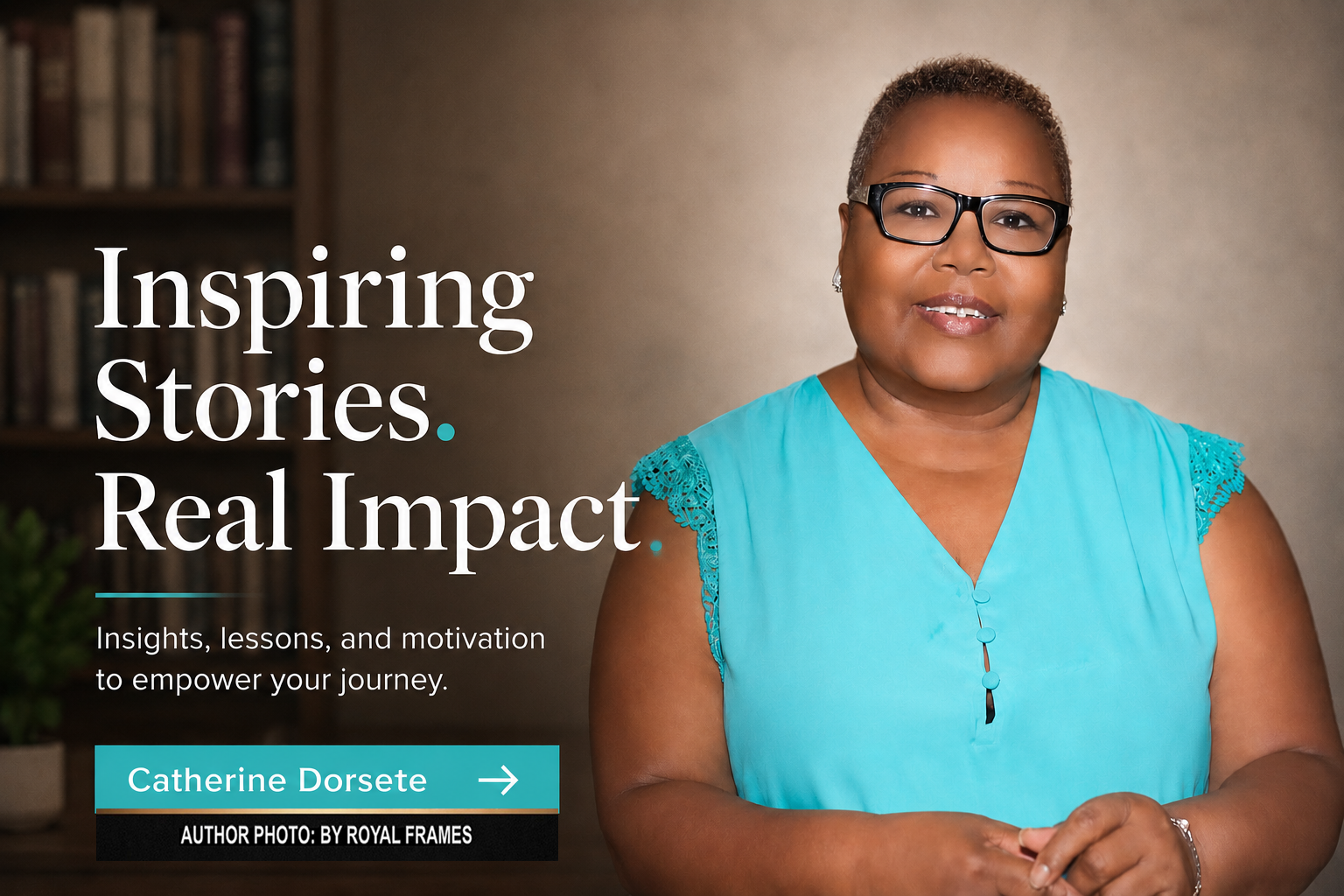
The Exercise Book: How Catherine Dorsette Became One of the Caribbean’s Most Prolific Storytellers
Catherine Dorsette’s writing career began with a lie, a beating, and then a gift.
As a child growing up in Dominica, every night, Dorsette’s mother would ask her to read aloud from whatever book she’d brought home from the library near DBS Radio in Roseau. The trouble was, those books were rarely storybooks. “The books were just old mathematics books, or some kind of technical books,” Dorsette recalled during a conversation on TDN Radio Caribbean’s This Week in Interview with host Anthony Drigo. “So, there wasn’t a story to tell.” Therefore, each night, she made one up. It worked until the night her mother asked her to read a story she’d particularly liked the night before, and Dorsette, having invented it on the spot, couldn’t remember a word of it. Her mother, a woman with no patience for dishonesty, gave her a beating for lying. Then she did something else: she bought her daughter an exercise book. “She said, ‘Douxdoux, every time you think of a story, write it down,” Dorsette said. “And I’ve been writing ever since.”
That exercise book eventually became a career spanning more than twenty published books, a run of awards from literary and film organizations across the region, and, in her telling, a body of work she still describes less as a skill she built, than a gift she was handed. “I wasn’t taught it,” she said. “I didn’t go out and learn it. I just do.” Dorsette left school in what Dominica calls standard five, never sat the region’s common entrance exam, and worked for years as a journalist in Dominica with no formal qualification in English. She is only now, in her late fifties, completing a bachelor’s degree in social work. “Most of my books were done with just a primary school education,” she said. “I know it’s a gift.”
In 2001, Dorsette left Dominica for Montserrat, the island long nicknamed the ‘Emerald Isle’ for its resemblance to Ireland, both in landscape and, as it turned out, in ancestry. She noted during the interview that many Montserratian families carry Irish surnames from historical settlement on the island. She arrived nearly six years after Montserrat’s Soufriere Hills Volcano began erupting, a disaster that destroyed the island’s capital, Plymouth, along with entire villages, and displaced two-thirds of the population. Dorsette had visited once before the eruptions, in 1993, and remembered walking on a golf course she’d never seen the likes of back home. When she returned in 2001, the course was gone, buried. “I felt so heartbroken just about a golf course,” she said, “and I was asking myself, if I can feel so torn about something like that, I cannot even begin to imagine how the people felt, losing family and friends and property.”
That tension, between visible loss and the resilience required to keep living beside it, became the emotional foundation for her first novel. In 2015, as the Montserrat government marked twenty years of living with an active volcano, Dorsette wrote Fire on Montserrat, built around two lovers separated by the eruption, who reunite two decades later. She said she wasn’t certain how the story would end when she started it, but it resonated enough with readers that one, weeks after publication, called her in genuine distress to ask whether she’d killed off a character she’d grown attached to.
Readers wanted more, and Dorsette, who hadn’t originally planned a series, obliged twice over. Jordan followed the son of the first book’s central couple as he navigates a difficult relationship with the adoptive mother who raised him, and cautious first contact with his biological parents. The newly released third installment, A Woman Like Cass, closes what Dorsette now calls a finished trilogy: Cass, Jordan’s fiancée, helps him find the confidence to reconcile fully with his birth family, while a jealous rival’s scheme to kidnap Jordan and Cass’s daughter drives the book’s central conflict. “This one is it,” Dorsette said, “I’m not doing anything after A Woman Like Cass.” Drigo, for his part, was skeptical, noting she’d said something similar after each of the previous two.
Dorsette describes her process as instinctive to the point of resisting structure entirely. “I’m a panster,” she said. “I fly by the seat of my pants. The idea of outlining and planning a story kills me.” She said she typically starts with nothing more than a single image, or overheard phrase. A conversation with her brother Oliver Joseph Sr. about “defiance and humility” recently became the working title for a novel she’s currently writing called ‘Humble Defiance’. Additionally, a writing prompt asking her to imagine the backstory of a photographed dancer, became a short story in its own right. Even her endings, she said, sometimes surprise her.
What distinguishes her romantic fiction, in her own account, is a deliberate resistance to writing love scenes that lean on explicit content to hold a reader’s attention. “I want my readers to cry with the characters,” she said. “I want them to laugh with them, get angry with them and at them… but I also write in such a way that it is family friendly.” She pointed to a moment in one of her books where a husband’s private thought about his wife is rendered in a single italicized line, enough, she argued, to communicate intimacy without requiring explicit description. “The chemistry is there, the love is there,” she said, “so you still get a really good satisfaction… it’s just not out there!”
The trilogy is only part of a catalog that now runs past twenty titles. Dorsette pointed to an anthology built from a Facebook writing group’s weekly prompts, assembled with contributor comments included, that later drew formal interest from the University of the West Indies in Trinidad, which requested copies for use as research material with students. She’s also built a growing children’s literacy series, The Adventures of Moss and Fling, named for a mosquito and a housefly, that pairs short stories with comprehension questions and writing exercises aimed specifically at Caribbean classrooms. The goal, she said, is countering rote memorization with something closer to real comprehension and doing it with characters and settings that feel local rather than imported. “It is so much more effective,” she said of setting stories in a recognizable Caribbean world, “because our people behave the same way pretty much.”
There’s also a dormant but not abandoned ambition to bring the trilogy to screen. Encouraged by friends in the region’s film community, Dorsette registered a production company, Victory Films Entertainment (VFE), and shot a trailer for Fire on Montserrat at the Piton International Film Festival (PIFF) in Saint Lucia in 2017, hoping to attract production funding. That funding hasn’t yet materialized, though she hasn’t ruled out revisiting it, noting the story would likely suit a miniseries format better than a single feature given the scope of all three books.
Asked what she’d do if she were somehow forbidden from writing another word, Dorsette didn’t hesitate. “I’d get me a recorder,” she said, “and I would tell a story.” She used the moment to address listeners directly, particularly those who might be sitting on stories of their own without the formal education she once assumed a writer needed. “Nobody can tell your story like you, because it is yours,” she said. “Just write. Don’t let anything stop you. The only person who can stop you is yourself.”
Dorsette’s conversation with Drigo which this article is based on, took place a little over two years ago, when her thirteenth book, A Woman Like Cass, had just been released. She has continued publishing steadily since, and her catalog now stands at more than twenty titles, spanning the Fire on Montserrat trilogy, standalone fiction, poetry, and educational children’s literature under her Aunty Kate banner.
To support Catherine Dorsette’s work, visit her website at catherinedorsette.com or find her full catalog on her Amazon Author Central page.
Thank you TDN for the exposure and promotion of my work as a Caribbean Writer/Author.
Fantastic writings from this author. It is worth the reading time.