
Climate-Smart Farming Is the Caribbean’s Next Big Opportunity, Says Dominican Agro-Entrepreneur
Once a month, host Anthony Drigo brings on his program, This Week in Interview on TDN Radio Caribbean, a recurring guest he’s stopped introducing as a guest. “I’m calling him a co-host from now,” Drigo said, “because if you come on every month, you’re not a guest, right? You home people.” The segment is called Make Agriculture Great Again. Pastor Adrien Bannis, is a farmer, agro-processor, and consultant who runs Bannis Farms in Castle Bruce, Dominica.
This past June’s installment, covered what Bannis calls climate-smart agriculture: farming built specifically around a country’s weather risks rather than around inherited habit. It’s a topic he’s clearly spent years thinking through in granular, practical detail, and one he tied directly to a second theme Drigo wanted to explore, whether the approach could make agriculture attractive again to young Dominicans who have largely written the profession off.
Asked for a plain definition, Bannis said. “Climate agriculture is really farming according to your climate,” he said, “because there different climate activities. Where you’re having lots of rain, not the rain like before, heavy, heavy rain. Then you have sun, almost drought.” The goal, he said, is choosing crops that can survive whatever the season throws at them: “We have to come up with ideas so that we can, within the climate, plant and grow food that will be climate resistant.”
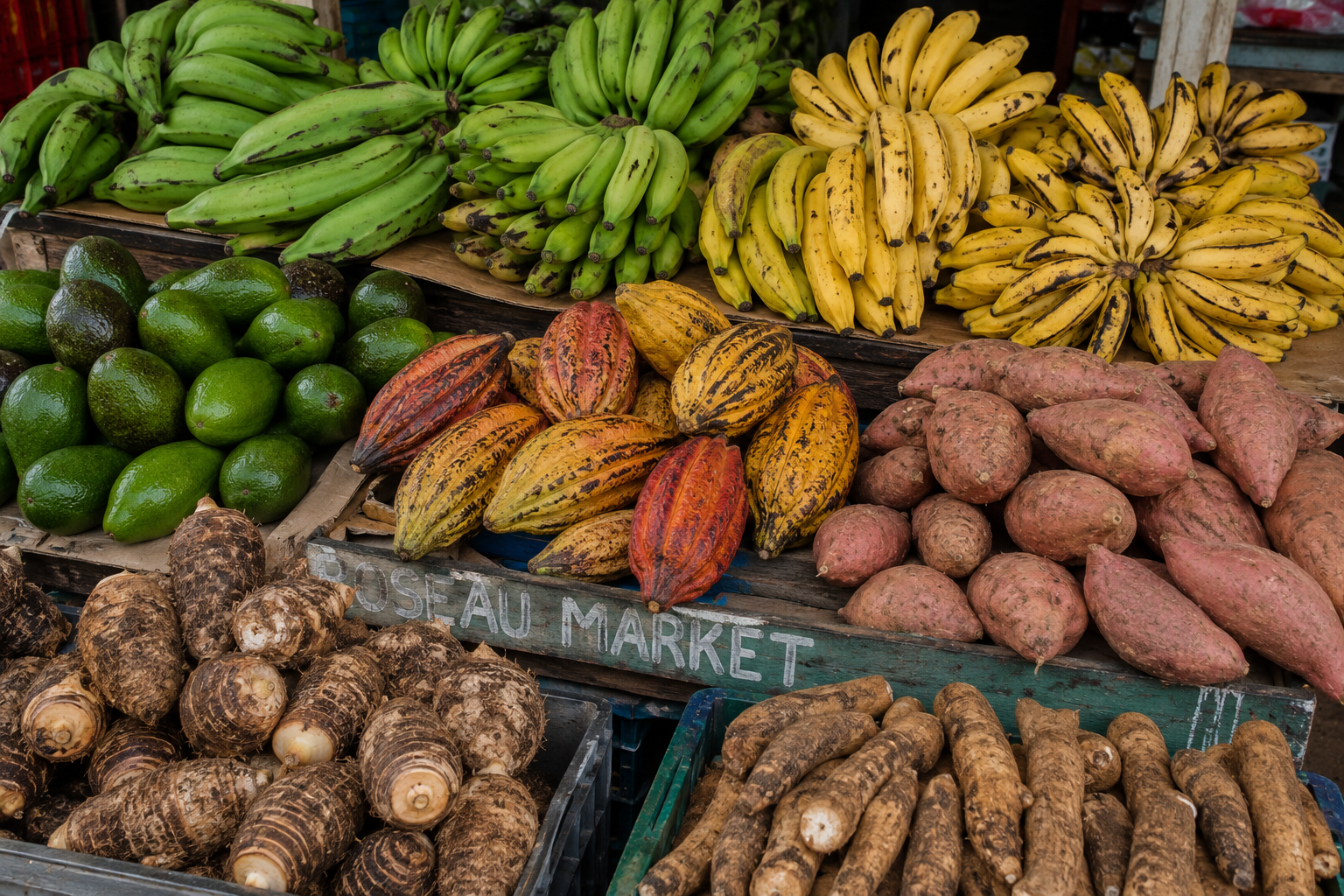
The clearest version of that strategy is root crops. “If a hurricane blow, you don’t have to go back and plant again,” Bannis said. “You just continue to take care of it.” He named sweet potato, dasheen, tania, and yams specifically. Above ground, he applies the same logic to fruit trees, favoring varieties like avocado and cocoa that “grow back as quick as possible” after storm damage, rather than slower trees that take years to recover.
Drigo pushed the definition further, framing it as a kind of risk-mapping exercise similar to infrastructure planning. “Just like you do utilities,” he said, “if we’re in a hurricane-prone country, instead of running your electric and telephone and internet wires above ground, if you can afford it, you put them underground. So similarly, you’re saying get crops that are underground… and for the above ground, find out which crop and which trees are less affected or recover quicker after a storm.” Later in the broadcast, he added the terrain dimension explicitly: whether a farm sits in the flat land around Castle Bruce or in the hills, in the drier Salisbury area or a wetter zone, and how often the region has historically taken a direct hurricane hit versus a lesser tropical storm.
Bannis returned more than once to Hurricane Maria, the 2017 storm that devastated Dominica, using it to illustrate both a mistake and a payoff.
The payoff came from products he’d already processed before the storm hit. “I need to example, when Maria blew,” he said, “chips, and the chips sold in a shake.” Fresh produce across the island had been wiped out, but bagged, dried chips he’d made in advance sold almost instantly once demand spiked. “Could you imagine if you had around ten or fifteen barrels of chips, or you had about a thousand carton, do you know how much money you would have made during that time?” It’s a lesson he ties back to how Caribbean farmers have traditionally planted. “Remember how we farming in the Caribbean, we only plant seasonal,” he said. “But in this time that we are living in, we need to plant every day, every month, to make sure that you always have.”
The mistake involved coconuts. As chairman of Dominica’s coconut platform when Maria hit, Bannis had already arranged nurseries to propagate new trees from the island’s own surviving stock. “We had already set up the nurseries to put the coconut plants,” he said, “and we were going to take the coconut plants from our coconut.” Officials changed course and opted to import replacement plants instead. Bannis argued against it, and was overruled; those imported coconuts later showed up in the Dominican Republic carrying a disease serious enough that authorities there destroyed the shipping container rather than risk it spreading. “In the DR, they just burned the whole container,” Bannis said. He used his own farm’s original stock instead. “Now I have a coconut tree, one tree making a hundred coconuts in a bowl,” he said. “Could you imagine?”
Bannis was openly skeptical of how loosely “food security” and “climate-smart farming” get used in official circles. “Everybody jumping on food security. Everybody jumping on climate-smart farming,” he said. “To me they turn it into even now a big business in theory, but in practical, to me, they do not even know what they doing.”
His example: a government meeting about establishing a seed bank. “You are not saying what kind of seeds that you are going to put in the bank,” he told the officials in the room, pointing out that a hurricane-prone country needs a seed bank stocked with specific, storm-resilient varieties, not a generic inventory assembled because the label sounds reassuring. “It’s not just saying you’re going to do something,” he said, “but what you’re doing must make sense, and it must not just make sense for now. It must make sense for the long term.”
A recurring thread in the conversation was Bannis’s insistence that traditional farming knowledge deserves to be taken seriously alongside newer techniques, not discarded in favor of them. He described an older farmer he knew as an extension officer, referred to as WGA, who planted bananas strictly according to the phases of the moon. “He would dig all the holes, put the plants in them, and when the full moon day come, he plant his bananas,” Bannis said. “He told me if you plant bananas at full moon, he gets a very big bunch and a long bunch.” Whatever the underlying mechanism, Bannis said the results held up: “He used to have a lot of bananas. He didn’t have a big field, but he used to have lots of bananas, nice, big, healthy bananas.”
Other examples came quickly: not planting potatoes when the moon is visible, because the crop is said to be more prone to worms; avoiding tree planting when the moon is rising, which is believed to make trees grow tall and spindly rather than wide and sturdy; and certain windows in the lunar month when pruning is avoided altogether. “Not necessarily unscientific,” Bannis said. “It’s just that maybe we didn’t have the scientific explanation. But as we apply it and we take notes and we keep data, we realize that there is validity in some of those things that we thought was just, you know, old folktales.”
He’s applied the same instinct to fertilizer, moving away from synthetic herbicides like Roundup. “Roundup is a systematic,” he explained. “It goes into the soil and it stays there for a while,” and he came to believe it was suppressing tania he wanted to grow nearby. In its place, he composts, piling vegetable peelings around the base of trees the way his parents’ generation did without ever calling it organic farming. “Our parents used to grow food in their backyard, and they never used to give away, they’d throw the peelings and whatever else in that area,” he said. He credits the shift with better storm resilience directly: “When a hurricane blew, these trees were not falling out. They would be battered, but then they recover quickly, and even some of them that were toppled, they would just continue growing.”
Roughly the second half of the conversation turned to Drigo’s central question: how to make farming a career young Dominicans actually want, rather than one they associate with hardship. Bannis was blunt about the underlying economics. “Food must sell,” he said. “Because people must eat. They must eat. You might not buy a clothes, you might not buy a shoe. You must buy food.”
He argued the opportunity extends well past growing crops. “One of the most valuable commodities in the world today is data, information,” he said, describing an opening for tech-savvy young people to simply travel around, talk to farmers, and start recording what soil types they use, what crops they grow, and how much they yield per acre. “Once we start collecting information, that information now becomes valuable,” he said, “because somebody else who wants to go into agriculture can say, okay, this is my soil, similar to Adrien’s soil. Adrien gets so many pounds of dasheen per acre… if I plant an acre of dasheen, I can reap so much.”
From there, he sketched an entire value chain of roles that don’t require anyone to farm directly: sales and distribution (“you can buy the fruits from the farmer and go distribute it to the hotels and restaurants”), agro-processing and food science, product development and marketing, and even transport and logistics, floating the idea of a group of young investors pooling money for a $3.5 million vessel capable of moving both vehicles and fresh containerized cargo between islands. “You can’t go wrong,” he said, “because the market is now opening.” He pointed specifically to the Bahamas, which he said is looking to import more than two million dollars’ worth of fresh and value-added Caribbean produce as it tries to reduce its reliance on food shipped in from the United States, an effort CARICOM is actively supporting.
Drigo connected the pitch to Dominica’s banana era, when the crop’s profitability pulled young people into agriculture on its own. “A lot of young people went into bananas because it allowed them to be able to buy a vehicle, to build a house, and on the weekend to dress nicely and to go out in a social way,” he said. “I think similarly, if we can show that young people… they would be interested in farming.”
Bannis is trying to build that proof of concept directly. He’s working with a local agricultural college to establish a demonstration plot after hosting a group of students on his own farm. “I heard a student say, ‘Boy, best I go into agriculture when I leave school,’ because it look like agriculture have money,” Bannis recalled, calling it evidence that seeing the real economics changes minds faster than classroom theory does. Bannis Farms also runs its own summer program, open to participants aged 13 to 30 across two one-week sessions in late July, teaching farm establishment and pruning one week and value-added processing, including solar drying and cocoa fermentation, the next. Details are posted on the Bannis Farms Facebook page.
As the segment wound down, both men circled back to the storm-preparedness theme that opened it. “We approaching the hurricane season,” Bannis said. “I want to encourage farmers, those of you out there, please try as much as possible to prune. The lower the trees are, is the less damage you’re going to get.” He added a direct appeal to young listeners: “Begin to think that you can become a professional farmer, and you can make money out of farming. You just have to do it well.”
Drigo closed with a challenge to turn the conversation into action, encouraging listeners to visit Bannis Farms in Castle Bruce directly. “Talk to Adrian, see what he’s doing,” he said. “You’re going to leave there inspired.” He credited the island’s underlying position as unusually strong for exactly this kind of agriculture. “Dominica’s natural advantage is agriculture and water,” he said. “We have land, fertile land, that if we manage it properly… all of the food that we possibly can produce will not be enough after we feed ourselves, to export to the other islands.”
Bannis’s own closing note was less about policy than posture. “Sometimes people wait on the government to give them,” he said. “The government is not going to do anything for you… so we have to make our own opportunities and step out in faith. I like to use the word risk.”
The Make Agriculture Great Again discussion returns this July, same time, same show, with Bannis back in the co-host’s chair. Meanwhile you can catch-up and watch the full episode here.
And follow TDN Radio Caribbean for more interesting discussions on YouTube, Veestreamz.com, Instagram and Facebook visit LinkTree for all available links.
Sign in to comment
Signing in is optional. You are welcome to fill in the form below instead.