
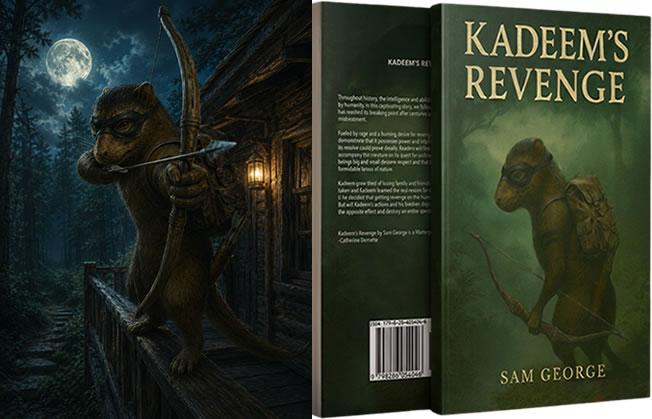
Dominican Author Sam George Turns a Childhood Hunting Story into an Animal’s Revenge
Sam George spends most of his working life either writing code, typesetting and designing books for other authors. When he’s not doing that he’s writing short stories and poems, and working behind the scenes, as producer and station manager at TDN Radio Caribbean, he’s the one cueing up other people’s interviews, not sitting in the guest chair. In a recent Wednesday episode of This Week in Interview, host Anthony Drigo flipped that arrangement, bringing George to the front of the camera to talk about his newly released book, Kadeem’s Revenge.
“It’s good to see you come move from behind the camera to the front of the camera,” Drigo said in welcoming him. “It’s always good to be on this side of the thing,” George replied. “It’s a few times, but every time, you know, it’s special.”
A Joke That Became a Novel
Kadeem’s Revenge follows the title character, an agouti, a large rodent native to Dominica and prized locally as a delicacy, who turns the tables on the humans who have hunted his species for generations. The premise traces back to a running joke George had with his father, an avid hunter of both agouti and manicou, Dominica’s two most commonly hunted wild animals.
“Growing up, my dad always loved, he loved hunting agouti,” George said. “So when I got to a certain age I myself was no longer interested… but I used to tease him all the time. I used to tell him, ‘You love hunting agouti, one day agouti will hunt you back.’”
That line sat with him for years before it became anything more. “A few years ago I told him, you know, I have an idea for a book, to write a book about an agouti that wants revenge on human beings, and he starts laughing,” George recalled. “He said that would be interesting.” The book took a long time to finish despite its modest length, around 78 pages, George said, because of repeated rounds of rewrites and editing. “I wanted it to be good,” he said. “I think they say there’s at least one book every writer has that’s close to their heart. This one is it for me… because of the connection to my father.”
George said he chose the agouti over the manicou partly because of the animal’s specific character. “I think I felt like the agouti was a bit more aggressive than the manicou,” he said, and partly because of its status as a distinctly Dominican animal. He noted during his research that the agouti has a South American relative sometimes called the paca, but said “the Dominican agouti to me is special.” He and Drigo also traded observations about the two animals’ different temperaments: the manicou, they agreed, is the more common and less cautious of the two, often seen crossing roads at dusk, while the agouti stays deeper in the forest. George added a detail he hadn’t set out to research: agouti pairs, he learned only after he’d begun writing, tend to mate for life. “Maybe human beings can take a lesson from them,” he said.
Drigo asked George to place the book within a specific literary tradition, one both men connected to their own childhoods: an oral storytelling culture built around animal characters like Compère Lapin and Compère Tig, given human speech and, often, special powers to carry a story’s meaning.
George described Kadeem’s Revenge as sitting in the action-adventure fantasy category, with elements of dark fantasy and magical realism layered in. “In order for humans to understand animals at the level that humans are understanding the animals in this story, there has to be some kind of magical thing going on,” he explained. He was careful to distinguish the genre from straight science fiction, which he said requires some grounding in real-world science, from fantasy, which doesn’t: “Fantasy, you can make up whatever you want… your characters don’t have to have human features.”
The book, George said, is part of a broader project he and other writers in the Peton Noir writing collective have been pursuing: blending Dominican and Caribbean folklore with the conventions of North American science fiction and fantasy. “That’s exactly the point,” he said. “We tell sci-fi stories or fantasy stories but with a Dominican or Caribbean folklore twist included.” Sometimes, he added, that connection is as simple as setting a story in Dominica or the wider Caribbean, or including a Caribbean character, without necessarily building the folklore connection any deeper than that.
Much of the conversation turned to a tension George has thought about at length: Dominica’s storytelling culture has historically been an oral one, not a written one, a legacy he traces to enslaved Africans who were forbidden from reading or writing and developed other ways to pass on their experiences. “That’s one of the reasons for things like Creole/Kwéyòl and things like Calypso,” George said. “The oral tradition was very, very strong in Dominica for a very long time,” he added, noting that it persisted on the island even after it had faded in some neighboring territories.
Despite that, George pointed out that Dominica has produced a large number of published authors relative to its size, second in the region only to Trinidad and Tobago by his estimate, while some other Caribbean islands, he named St. Kitts and Nevis specifically, have little in the way of an established literary scene at all.
Even with that base of writers, George was candid about the practical obstacles Dominican authors face in reaching readers at home. Distribution remains one of the biggest: “Amazon, for example, will not ship to Dominica,” he said, “or if they do ship, the shipping cost will cost more than a book.” Local printing capacity is limited too, he said. Dominica has printers, he explained, but functionally no book binders, meaning that some authors have had to send their manuscripts as far as the United Kingdom to be printed and bound before shipping finished copies back to the island.
Reading from the novel’s back-cover synopsis, George described Kadeem’s Revenge as the story of a creature who, after generations of mistreatment at human hands, resolves to prove that animals possess an intelligence and resolve too easily dismissed. In the novel, Kadeem loses his older brother to human hunters and, after learning the full truth of what has been happening to his fellow agouti, concludes that only retaliation can restore peace to his community. George read a short passage from an early chapter, describing an unnervingly silent forest and the narrator’s dawning sense that “this wasn’t a hunt. It was an invasion.”
Author Catherine Dorsette, credited on the book’s cover, called it “a masterpiece,” with a full review on the inside, according to George, who said he was humbled by the endorsement given Dorsette’s own standing as an award-winning writer. The manuscript was edited by Nicole Georges-Bennett, George’s longtime writing collaborator.
Asked whether the book carries a deliberate moral message, George was measured. “I wasn’t intentionally trying to write a moral story,” he said, “but the more I read it now that it’s complete… I realize that there are a few lessons that we can pick up from Kadeem’s revenge, you know, from not being impulsive, for one thing.” He didn’t rule out that readers might come away thinking about the ethics of hunting more broadly, distinguishing between hunting for sustenance and hunting purely for sport or trophy, which he called “just barbaric.” But he stopped short of framing the book as an argument against hunting or eating wild game altogether. “It’s really more, it’s serious, but it’s also more of a fun story,” he said, describing it as, in part, a small slice of what it was like growing up in rural Dominica.
Kadeem’s Revenge is available on Amazon in both paperback and Kindle formats; George said an audiobook version is in the works, pending scheduling with a narrator. He encouraged listeners to leave reviews after reading, noting that reviews help a self-published book’s visibility on the platform. “Support Dominican authors,” he said, pointing listeners toward the Nature Isle Literary Festival’s Facebook page, which curates and archives cover art from Dominican writers, as one way to discover more titles from the island’s literary community.
George is already working on further material, including a fourth installment of a separate series he co-writes, The Flying Crapaud, alongside what he said were at least two or three more projects in edits before the end of the year. “You cannot rush perfection,” he said, laughing.
Kadeem’s Revenge is available at Amazon.com
And you can watch the full interview here.
Sign in to comment
Signing in is optional. You are welcome to fill in the form below instead.